


The next summer is coming. How to make a care household ready.The next summer is coming. How to make a care household ready.
The summer of 2026 was the deadliest heat summer since records began, and it hit old and frail people hardest of all. What helps is known, affordable and easiest to organise in the cool half of the year: a guide for the months until the summer of 2027.
The summer of 2026 was the deadliest heat summer since records began, and it hit old and frail people hardest of all. What helps is known, affordable and easiest to organise in the cool half of the year: a guide for the months until the summer of 2027.
At a glance
- What happened: Around 16,300 heat-related deaths up to the end of August, more than in any year since 1992. Three quarters of them people over 75.
- What helps: The same as for everyone else — drinking, cooling, shade. The difference is that for someone with limited mobility, each measure has to be one reach or one spoken word away.
- When: The applications to the care insurance fund now, because they take months. Everything else calmly over autumn and winter, when devices are in stock and cheap.
- With what: Bottles with a tube. Fan and air conditioner by voice. Shutters that close by themselves. And a network of people that technology only complements. Straight to the checklist.
A summer you do not forget
For the period up to the end of August, the Robert Koch Institute estimates around 16,300 heat-related deaths in Germany — more than in any year since records began in 1992. The previous peaks stood at 10,200 in the summers of 1994 and 2003.
Who died surprises nobody who cares for someone: three quarters were older than 75. And the institute considers its own figure conservative, because heat rarely appears on a death certificate. Usually it is the combination of heat and an existing condition that tips the balance.
Heat-related deaths in Germany
Where the figures come from
Figures: Robert Koch Institute. The annual values for 1992 to 2024 come from the appendix to Epidemiologisches Bulletin 19/2025 (CC BY 4.0); the values for 2025 and 2026 come from the weekly reports on heat-related mortality and each run up to calendar week 34, which makes them provisional. The institute publishes age groups only for the current summer, so the second view shows 2026 alone. All values are model estimates and are rounded.
We saw this close up. My mother had to go into hospital this summer because of the heat. And we are a household that was prepared. Or so I thought.
Anyone who has lived through a summer like that knows the feeling afterwards: there is nothing you can do about the weather, and next time it will not be better. In an attribution study, the German Meteorological Service says the heatwave at the end of June would have been statistically impossible without climate change. Which means: it will come again.
About the weather there really is nothing to be done. But you can prepare, and the best moment for that is now — when nobody is sweating, everything is in stock, and a whole autumn, winter and spring lie ahead to apply for things, buy them and practise them. That is what this article is about: not the summer that was, but the one that is coming.
One note first: what follows are lessons and tactics from a household where a person who needs care lives at home, alone or with family who are not there around the clock. Care homes work under different rules and different responsibilities.
Frail people need nothing different. Just differently.
Everyone knows the heat advice: drink plenty, keep the flat cool, air it in the morning, shade it during the day, stay out of the sun. It is all correct, and it is correct for people who need care too. The needs are not that different. It is the routes to them that have thresholds healthy people never see.
When I am too warm, I stand under a cold shower. Someone who needs help showering waits until the help arrives. And for some circulations a cold shower is too much anyway. “Drink plenty” is good advice until the bottle is at the other end of the room, the hand is too stiff to open it, or the cup is suddenly too heavy because the heat is already draining their strength. On top of that, older people sweat less and feel less thirst. The body does not report the shortfall, and the way to the bottle is too far.
So the work in a care household is not to invent new tactics. It is to lower the thresholds in front of the known ones, until every measure sits so close to what the person can do that they can carry it out themselves. One reach away. Or one word . Anyone who has read the Alexa article will recognise the idea.
Before the devices, though, there are two things to settle that no technology replaces.
To settle first: the conversation and the money
The conversation
Most people who are cared for today come from a time when heat was not a subject. Thirty or forty years ago there were no summers like this, and you were young enough to shrug off a hot day. Out of that grew an attitude: you put up with it. A fan? Then there is a draught. An air conditioner? That is for offices. Shutters down during the day? Then you are sitting in the dark.
That attitude is not stubbornness but experience, and the experience was true. So there is no point in talking over it. There is a point in taking it seriously: what was different back then? What happened this summer? What would help without it feeling like a hospital? That is a conversation between equals, and it is best held in the cool season, when nobody is sweating and reason gets a word in — not on the first hot night, when both of you are irritable.
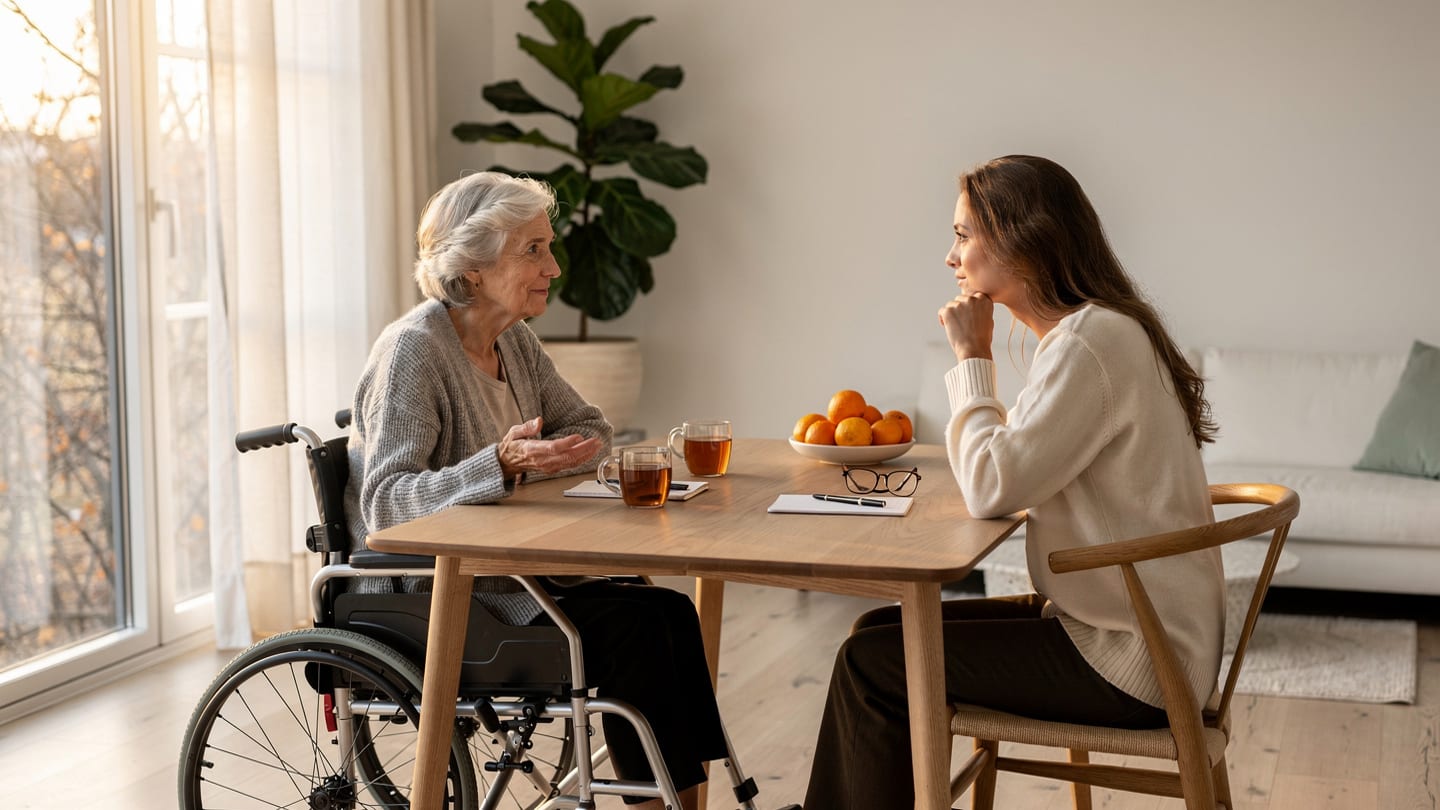
The reason the conversation comes before the technology is simple: an aid that is not wanted does not get used. The fan stays in its box, the air conditioner stays off, “because of the electricity”. Only what was decided together also runs when nobody is watching.
The money
The elephant in the room: money . A good fan is affordable, an air conditioner not necessarily, motorised shutters for several windows least of all. And people who need care are not known for deep pockets. Three ways to handle it.
Apply to the care insurance fund. The lever is called wohnumfeldverbessernde Maßnahmen — measures that improve the living environment — under Section 40(4) SGB XI: anyone with a recognised care level can receive a grant of up to €4,180 for adaptations that make care at home easier or allow a more independent life.
For a long time the funds rejected air conditioners as a comfort item. In 2025 the Mainz social court decided otherwise (case S 9 P 76/23), in the case of a woman with impaired thermoregulation and a markedly raised risk from heat. The line since then: the fund has to pay when the measure is tailored to the specific medical situation — for instance with cardiovascular, lung or neurological conditions where heat demonstrably leads to deterioration — and when milder means are not enough. Motorised shutters and shading fall under it too.
Important: the application has to be made before you buy, and the amount applies per measure. So apply for the air conditioner, the shutters and the voice control together as one measure, “protection from heat”, with this summer’s doctor’s letter as the justification. Help with the application and with an objection is free at care advice centres (Pflegestützpunkte) and welfare associations.
But anyone who deals with insurance funds regularly also knows: this route takes time, it is tiring, and sometimes it bears no fruit. Which is exactly why it is the one thing in this article that really has to be started now. If the answer is yes, the unit is in by spring. If it is no, there is still time for plan B.
Buy it yourself, but cleverly. 2026 showed how cooling devices behave in summer: between May and July, the price comparison site guenstiger.de reported a 511 per cent rise in demand for fans; the average price went from €332 in June to €434 in July, partly because the cheap models go first. In mid-July the retail association BVT reported that fans and air conditioners were largely sold out. Buy in autumn or winter and you have a choice and pay less.
What two cooling devices cost over the year Prices: Geizhals Germany, best daily price across all listed retailers from 4 September 2025 to 3 September 2026, retrieved on 4 September 2026. Where the line breaks off, nothing was on offer that day. List prices as stated by the manufacturers (Dyson via PC-WELT, Bosch via bosch-homecomfort.com). Heat periods according to the German Meteorological Service (DWD). One widely sold device was picked per class from the best-selling models on Amazon and Geizhals.Where the figures come from
And yes, it remains a scandal. That families have to organise their relatives’ protection from heat through social courts and Christmas presents, while the Robert Koch Institute counts thousands of deaths year after year, is a political choice. This summer, more than 150 health and care organisations called for protection from heat to be written into crisis preparedness as a binding duty. Until that happens, it is left to us.
Ordinary solutions, made to fit
Three measures everybody knows: drinking, cooling, shade. What follows is how they end up one reach or one word away in a care household.
Drinking: water one reach away
Staying hydrated is the most important point, and it is the easiest to solve.
My mother has two bottles built for exactly this. At night The Hydrant, originally developed for British hospitals: a bottle with a handle for the bed rail and a tube with a bite valve that lies beside her head. During the day the Giraffe Bottle Tower XL: an insulated stainless steel bottle with a long, bendable neck you bend round to your mouth. Teeth together, drink, let go, sealed. With a bracket it sits on the wheelchair or by the bed.
That is one to two litres of water that no longer has to be gripped, lifted, opened and put down. The effort for a mouthful is zero. And that is exactly why it gets drunk.
The tactic behind it, in three steps:
- Insulated bottles with a gooseneck or a tube, so the water stays cool and nothing has to be lifted.
- Several of them, placed tactically: by the bed, by the armchair, at the dining table, in the bathroom, and one on the wheelchair that travels along. The German federal health institute recommends exactly this: put drinks out in several places around the home.
- Eat your water. Melon, cucumber, tomatoes, cold soups, yoghurt: meals with a high water content, small and several times a day instead of once and large. Someone who drinks little still takes water in this way.
If you are not there in person, ask: “How much have you had to drink today?” The call via Echo is the shortest route for that.
Cooling: fan and air conditioner by voice
Having the device is one thing. Being able to operate it is another. Someone who cannot get out of bed or out of their wheelchair cannot switch on the fan in the corner, and cannot switch it off again at two in the morning either. The lowest-threshold control I know is your own voice: nothing to reach, nothing to press. Three routes there, from the most comfortable to the cheapest.
I am talking about Alexa here because that is the system we settled on years ago and the one I know. Everything here works with Google Home or Apple Home too, but my experience is with Alexa.
Option 1: smart from the factory. Fans and air conditioners with app and voice control built in. Comfortable, no tinkering, settings and temperature directly by voice. The price is the catch: smart air conditioners run into four figures quickly.
Option 2: a smart plug for the fan. An Echo Dot costs little, a smart plug even less. Plug the fan in, name the socket in the app, done: “Alexa, fan on.” One detail decides whether this works: the fan needs a mechanical rotary switch, not a digital keypad. Digital devices start in their default mode after a power cut, usually too strong or not at all. A dial stays where you turned it: set it to speed 1, power on, it runs at speed 1. Power off, it is off.
Option 3: replace the remote control. Air conditioners cannot be controlled by power on, power off, but almost all of them have an infrared remote. An IR hub such as the SwitchBot Hub Mini learns its signals and connects to Alexa, Google or Siri. It needs line of sight, and infrared has no return channel: the hub does not know whether the unit is running. For “air conditioner off” that is enough; sometimes you have to repeat the command. Anyone planning automation should take the larger model straight away: it measures temperature and humidity and supplies the value a rule like “above 26 degrees” can refer to.
Shade: catching the heat in front of the window
The underrated part. A room the sun never gets into does not have to be cooled in the first place. The rule: what stops the sun in front of the glass works. What stops it behind the glass only dims the room. External shading can catch up to 75 per cent of the heat coming in; curtains and blinds on the inside let the heat through the glass and spread it around the room. Shutters down during the day, left ajar so the heat does not build up behind them; air the place at night and early in the morning. Two starting points.
Option 1: no shutters at all. Then it is about getting something in front of the glass anyway, in three steps. Solar film on the outside of the glass is, according to Öko-Test, the most effective measure without building work, and for tenants often the only one; it does darken the room all day, though, and achieves less than a shutter. An external clip-on blind mounts on the outside of the window frame without drilling and can be raised and lowered by hand. If you own the place, or have a landlord who will play along: retrofit front-mounted shutters — the best lasting solution, and exactly what the application to the care insurance fund is meant for. Until then, in an acute heatwave: a survival blanket taped to the outside of the window. It does not look good. It works.
Option 2: shutters are there, so let them close by themselves. That is our route. My mother’s flat had ordinary shutters with a belt that she cannot pull up herself. We retrofitted them with the RolloTron system from Homepilot: the electric belt winder replaces the old one, the belt stays, no electrician needed. Today I would go straight for the gateway and the RolloTron pure smart — the main thing is an app and a voice assistant.
Then three things work together. My mother says “Alexa, shutters down” when she wants to. A schedule lowers the shutters in the late morning in summer and raises them in the evening. A sun sensor at the window moves them to a set position when the sun is strong. The heat stays outside without anyone having to remember. Cost: around €130 per window for the belt winder, the gateway once, the sun sensor under €20. Not cheap, but exactly what the care insurance fund means by “a more independent life”.
Beyond the devices
Technology lowers thresholds. It replaces nobody, and it must take nobody’s say away. Two things therefore belong in the months before the next summer just as much as the devices do.
A social safety net
Three agreements , and none of them has to happen this week.
With the doctors. Blood pressure medication, diuretics, beta blockers and sedatives change their effect in heat. The federal health institute advises clarifying with a doctor or pharmacist before the next hot period whether the dose or the time of day needs adjusting — and never stopping anything on your own.
And, in our experience the most important agreement of all: what do we do when too little is being drunk? Heat rarely kills directly. It takes water out, and with an underlying condition that shortfall triggers things that seem to have nothing to do with heat: infections, circulatory collapse, confusion. A drip during a home visit is a small intervention; the hospital stay after waiting too long is a large one. That threshold — “I do not want to make a fuss, I will not call yet” — is the most expensive one of the whole summer. Lowering it means agreeing in advance: with these signs we call, no discussion.
With the care service. If one comes: adjust visiting times during hot spells, record how much is being drunk, know the warning signs.
With family, neighbours, friends. During hot spells, call more often and come round more often, ideally with a fixed plan of who comes when. And subscribe to the German Meteorological Service’s heat warning : it comes at an apparent temperature of 32 degrees, two days ahead. Two days are enough to activate the network.
Automate, but keep a rip cord
As soon as shutters, fan and air conditioner hang on the smart home, it is tempting to automate everything: above 26 degrees the unit comes on, above a certain brightness the shutters go down. That is good, and we do it too. But only halfway.
A weakened person’s sense of temperature is not linear. The first coolness, when the unit kicks in, is a relief. After an hour of running it is unpleasant, sometimes properly cold. And then the automation has created exactly the state you wanted to avoid: the person no longer decides about their own surroundings. They are at their mercy — this time the cold’s. The same goes for shutters that close at eleven while she wants to read.
So: every automation needs a rip cord the person can pull themselves. Ours is as simple as it gets: “Alexa, air conditioner off.” And it is off. No menu, no app, no follow-up question. The same for the shutters. Automation may suggest and may make things easier. The person in the room has to decide. Autonomy is not a luxury; it is the reason all of this happens at home and not in a home.
Checklist
Everything from this article as a list, sorted by when it is due. The application first, because it takes longest; the rest when its time comes.
Now, because it takes time
- The conversation had: what went on this summer, what will we do differently?
- Application for measures to improve the living environment submitted to the care insurance fund, with a doctor’s letter, before buying anything
Until summer, calmly
- Medication list gone through with a doctor or pharmacist for heat tolerance
- Agreement with the GP: with which signs do we call, and is a home visit with a drip possible?
- Heat warning from the German Meteorological Service subscribed to
- Bottles with a tube or a gooseneck, one per place the person spends time, one on the wheelchair
- Fan with a rotary switch and a smart plug, voice command practised
- With an air conditioner: IR hub taught the signals, “on” and “off” tested by voice
- Shutters: schedule, sun sensor and voice command set up — or film, external blind, curtain fitted
- Every automation has a rip cord by voice
- Spray bottle, damp cloths, a hot-and-cold bottle within reach; medicines stored below 25 degrees
When the warning comes
- All systems tested once: voice, plug, shutters
- Network activated: who calls when, who comes round
- Care service informed, intake of fluids being watched
- With dizziness, weakness, confusion or a fast pulse: coolest room, drink, call the doctor. If consciousness is clouded: 112.
In the end
The summer of 2026 showed how vulnerable a care household is in heat . But it also showed what helps. Most of it already exists, it does not have to be complicated, and with a bit of luck and skill it is not unaffordable either. It is the same thing that helps everyone, only built so that a person with little strength and little reach can do it themselves: the mouthful of water is one reach away. The fan listens to a word. The shutter closes before the sun is in the room. And the call to the doctor comes an hour too early instead of a day too late.
None of it can be done in June. All of it can be done in the months until then, without rushing, one piece after another. The application first, because it takes longest. The rest when its time comes. And anyone who goes into the summer of 2027 that way goes in not with fear, but with a plan.
At a glance
- What happened: Around 16,300 heat-related deaths up to the end of August, more than in any year since 1992. Three quarters of them people over 75.
- What helps: Drinking, cooling, shade, as for everyone. The difference is that each measure has to be one reach or one word away.
- When: The application to the care insurance fund now, the rest calmly over autumn and winter.
A summer you do not forget
For 2026 the Robert Koch Institute estimates around 16,300 heat-related deaths, more than ever before since 1992. Three quarters of those who died were older than 75. Usually it is the combination of heat and an existing condition that tips the balance.
We saw it close up: my mother had to go into hospital because of the heat, although we thought we were prepared. The German Meteorological Service says the heatwave at the end of June would have been statistically impossible without climate change. It will come again. The best moment to prepare is now , when nobody is sweating and everything is in stock.
Frail people need nothing different. Just differently.
The heat advice holds for people who need care too. It is the routes to it that have thresholds: someone who needs help showering waits. The bottle is at the other end of the room, the hand too stiff to open it. On top of that, older people feel less thirst.
The work is to lower the thresholds in front of the known measures, until each one sits so close that the person can carry it out themselves. One reach away. Or one word .
To settle first: the conversation and the money
The conversation. Anyone cared for today comes from a time without summers like this. “You put up with it” is not stubbornness but experience. So it helps to take it seriously: what went on this summer, what would help without it feeling like a hospital? A conversation between equals, in the cool season. Because an aid that is not wanted does not get used.
The money. Anyone with a recognised care level can apply to the German care insurance fund for up to €4,180 for measures that improve the living environment, under Section 40(4) SGB XI. Since a 2025 ruling by the Mainz social court, the line is: the fund pays when the measure is tailored to the condition and heat demonstrably does harm. Important: apply before you buy, bundle everything as one measure, “protection from heat”, with a doctor’s letter. Care advice centres help free of charge, with an objection too. The application takes months, so it is the one thing that has to happen now.
Buy it yourself, but cleverly. In the summer of 2026 demand for fans rose by 511 per cent, prices by a third, and by mid-July almost everything was sold out. Buy in autumn or winter and you have a choice and pay less. Buy second-hand, spread the cost, let people give you the devices as presents.
Ordinary solutions, made to fit
Drinking. Bottles with a tube or a gooseneck and a bite valve, insulated, one by the bed, one on the wheelchair, more wherever the person spends time. A mouthful costs no effort any more, which is why it gets drunk. On top of that, eat your water: melon, cucumber, cold soups.
Cooling. The lowest-threshold control is the voice . Cheapest: a fan with a mechanical rotary switch on a smart plug, “Alexa, fan on.” Air conditioners through an infrared hub that replaces the remote; with a temperature sensor you can build rules like “above 26 degrees”.
Shade. What stops the sun in front of the glass works; what stops it behind only dims the room. Without shutters: solar film on the outside, an external clip-on blind, or retrofitted front-mounted shutters. With shutters: retrofit electric belt winders, no electrician needed. Then the shutters move on a word, on a schedule and on a sun sensor, without anyone having to remember.
Beyond the devices
A social safety net. Three agreements . With the doctors : check medication for heat tolerance, and agree in advance which signs mean a call, no discussion — because the threshold “I will not call yet” is the most expensive one of the summer. With the care service: adjust visiting times, record how much is being drunk. With family and neighbours: a fixed plan of who calls when, and subscribe to the heat warning from the German Meteorological Service.
Automate, but keep a rip cord. Automation is good, but only halfway: after an hour of running, the coolness is unpleasant, and the person is at the mercy of their surroundings again. So every automation needs a rip cord they can pull themselves: “Alexa, air conditioner off.” The person in the room has to decide.
In the end
What helps already exists, it does not have to be complicated, and with a bit of luck and skill it is not unaffordable either. It is the same thing as for everyone, only built so that a person with little strength can do it themselves. None of it can be done in June. All of it in the months until then: the application first, the rest when its time comes.
News by email
New blog articles straight to your inbox. Now and then there is news about our products too – but not often, we promise. You can unsubscribe at any time.